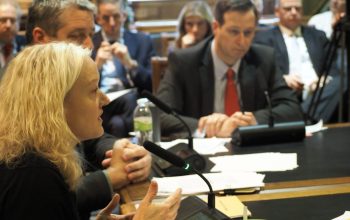
Kraig Paulsen, director of the Iowa Department of Management, spoke at the Revenue Estimating Committee meeting March 12, 2026. The panel updated projections on the state’s finances as lawmakers begin the budget negotiations. (Photo by Robin Opsahl/Iowa Capital Dispatch)
by Robin Opsahl, Iowa Capital Dispatch
March 12, 2026
The Iowa Revenue Estimating Conference projected Thursday that state revenues will decrease by 9.3% from fiscal years 2025 to 2026 — a larger drop than previously expected.
The last time the REC met, in December 2025, the panel estimated Iowa’s net revenues would decline by 8.8% from fiscal year 2025 to 2026, from roughly $8.94 billion to $8.16 billion. This figure was updated Thursday to project an additional loss of roughly $46 million, meaning a total 9.3% decrease in state revenues.
Kraig Paulsen, director of the Iowa Department of Management and REC chair, said the decreased projected revenues when compared to December estimates are “driven by a nationwide trend of lower corporate tax receipts,” primarily coming from provisions enacted through the federal “One Big Beautiful Bill” Act on issues like bonus and special depreciations.

Speaking with reporters, Paulsen said his calculations show the decrease in state revenues in FY 2026 were dollars that are now being put back in the private sector through tax provisions allowed in the tax and spending law approved by President Donald Trump and GOP lawmakers in Congress. He said he does not see the REC estimate as a reason to be pessimistic about Iowa’s fiscal future.
“My confidence is higher today than it was in December,” Paulsen said. “… I mean, there’s still things out there that we can’t control in the state that could upset the apple cart, but I feel pretty good right now. And without those companies taking advantage of the tax provisions in the One Big, Beautiful Bill Act, my expectation, or my calculations, would be that we would have increased (state revenues in) ’26. But instead of taking those dollars as profits, those companies reinvested them through different spendings that they could do and, like, say, accelerate that depreciation.”
Jennifer Acton, the director of the Fiscal Services division of the nonpartisan Legislative Services Agency, echoed that the estimated decreases in FY 2026 are due to the federal tax and spending bill as well as state income tax cuts, but said the agency was approaching projections on the state’s economic future with a more conservative mindset.
“Looking at the global economy and due to recent events taking place in the Middle East, there’s a lot of economic uncertainty on the horizon, which can adversely affect both Iowa and the national economies,” Acton said.
The national economy has shown it is “resilient and continue to grow stronger than expected over the past year,” Acton said, and Iowa has also seen positive economic growth through a 5% increase in the state GDP in the third quarter of 2025.
“However, Iowa’s agriculture and manufacturing economies continue to experience stress due to trade uncertainties, low commodity prices and high input costs,” Acton said. She also stated tariffs “continue to drive price increases and are expected to remain a significant factor in the foreseeable future,” and that gas prices have increased in the past month due to the war U.S. and Israel are conducting with Iran.
Due to these factors, Acton said, “despite recent economic growth, we believe it is prudent to be cautious as we look to the future.”
The Reynolds administration and LSA presented different estimates for the following year, FY 2027. While both entities projected the state would see a revenue increase, LSA projected 3.1% growth, to a revenue of $8.36 billion, while the state executive branch estimated a higher 5.8% jump to $8.58 billion in revenue.
Paulsen said the executive branch saw “strong indicators” that point to “meaningful growth” in increased revenues through state sales and use taxes, as well personal income taxes in FY 2027, while Acton said LSA was a “little more cautious” about projecting revenue increases, pointing to national economic uncertainty.
The REC members agreed to “split the difference” in making their projections for FY 2027, estimating a 4.4% increase to $8,471.6. billion. This is an increase from the December 2025 estimate of 4.2%.
House Minority Leader Brian Meyer said the updated REC estimates leave Iowa “staring down an unprecedented $1.3 billion deficit.” He said while Republicans have repeatedly stated they accounted for the expected loss in revenue from income tax cuts in the budgeting process, he asked, “when are Iowans going to see this growth, and when are they going to see the budget deficits go away?”
“If the budget was truly planned responsibly, why are we already seeing that the Ways and Means Committee is working to borrow against the Taxpayer Trust Fund to cover up this gap?” Meyer said. “And while all this is happening, Iowans are still asking a very basic question: what has the Legislature done to lower costs?”
Lawmakers in both chambers have moved forward a measure to impose a one-time tax increase of $173 million on health maintenance organizations (HMOs) in order to address budget shortfalls in Iowa Medicaid. The Senate version of the bill, Senate File 2464, also includes provisions to transfer $296.2 million from the Iowa Taxpayer Relief Fund and remove the 50% cap on money that can be taken from the Taxpayer Relief Fund to make up for the difference between state spending and revenues that would be transitioned back in by FY 2028.
The House bill, House Study Bill 762, makes a slightly different proposal, transferring money based on the reduction in state revenue associated with federal tax law changes, and allowing the general fund expenditure limitation amount to be calculated using the funding taken from the Taxpayer Relief Fund beginning in FY 2026.
Gov. Kim Reynolds told reporters her administration proposed the tax increase proposal on HMOs, but did not introduce the changes related to Taxpayer Relief Fund transfers.
In a statement Thursday, Reynolds said the REC estimates show Iowa “remains in a strong financial position as historic state and federal tax cuts have gone into effect, benefitting individuals and families, businesses, and our state’s economy.”
Iowa Capital Dispatch is part of States Newsroom, a nonprofit news network supported by grants and a coalition of donors as a 501c(3) public charity. Iowa Capital Dispatch maintains editorial independence. Contact Editor Kathie Obradovich for questions: info@iowacapitaldispatch.com.