by Amanda Rink, Editor
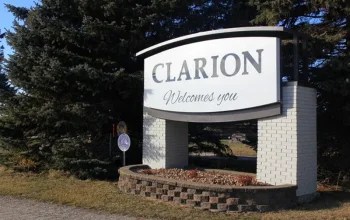
September 2, 2025 – The folding chairs filled quickly at the Clarion Public Library on Tuesday morning as Iowa State Auditor Rob Sand stepped to the front of the room, sleeves rolled, speaking with the urgency of a man who wants to “flip tables” in Des Moines.
But before the town hall began, Sand sat down with the Wright County Monitor for a brief interview. When asked how he would approach unity in a statehouse dominated by Republicans, he leaned into his independent streak. “There’s more than two ways to pay. And I always say I was a red shirt independent before I registered as a Democrat, but when I switched to vote in the primary, I didn’t leave my independent mind behind. There are some Democrats that are upset with some of the things that I believe — that’s too bad, but I’m always going to say what I think is the right thing, and not pretend that something else is going on.”
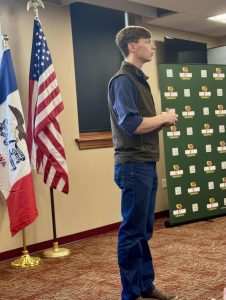
Sand continued: “When it comes to unity, I think actually that having divided government for the first time in 10 years would help provide [unity], because right now, in the state of Iowa, what we’re seeing is Iowans getting left behind. Our economy is 49th in the country. Our cancer growth rate is number one. So I look at that, and I think, you know, the only people they’re serving down in Des Moines right now are insiders and special interest groups. I think a lot of us — Democrats, Republicans, and Independents — have a lot of unity as outsiders who look at Des Moines and think it needs a little bit of shaking.”
Pressed on Iowa’s rising cancer rates, particularly in rural counties, Sand didn’t hesitate.
“Number one, I think there are some things that we know that we can do now. One of our leading cancers is lung cancer. We know that we have a tremendous amount of radon in the state of Iowa. The state of Iowa should be doing more to help diagnose and prevent that. Number two, we know that alcohol consumption is a leading cause. We drink a lot of alcohol in Iowa. We should do more on that. And then I think we should be really carefully studying what’s going on with water quality and figuring out how we can best improve our water quality.”
That focus on accountability carried into his town hall remarks. From the start, Sand set the tone by calling Iowa’s political system “broken” and inviting the audience to bridge divides — even leading the crowd in a spontaneous rendition of America the Beautiful.
Soon after, he compared the legislature’s recent efforts to weaken the auditor’s office to tying the hands of law enforcement.
“What happens if there are no sheriff’s deputies out there?” he asked. “That’s what it’s like when you tell auditors where they can’t audit. It’s an invitation to waste, fraud, and abuse.”
He connected that warning to the state’s school voucher program, which he called the second-biggest “pro-corruption bill” in Iowa history.
“You give people $100 million in tax money, tell them to spend it however they want, and then ban the auditor from looking at it? That’s not choice, that’s temptation.”
The questions from residents touched nearly every corner of Iowa life. One parent asked about guns in schools. Sand admitted it was “one of the toughest issues” given the current legislature. While he supports background checks and keeping firearms out of the hands of dangerous individuals, he also recognized the political reality:
“I’ll be working with Republicans who have passed bills without law enforcement’s support. The first step is to stop going in the wrong direction.”
A healthcare worker raised concerns about Iowa’s shortage of mental health providers. Sand cited his sister, a practitioner who had a full caseload just two weeks after moving back to Iowa.
“We don’t pay competitive wages. If we want people here, we have to raise reimbursement rates. That’s something Republicans and Democrats alike should agree on.”
Education dominated several questions, including those from a longtime school board member and registered republican, who shared the years of under-funding. Sand argued that local leaders, not Des Moines politicians, are best positioned to innovate and pointed to new tools like artificial intelligence to help teachers. On vouchers, he said he would “call their bluff” by demanding accountability: audits, public records compliance, and proof that dollars help students who actually need them.
When asked about the use of eminent domain for carbon capture pipelines, Sand did not mince words. “I do not support it. Period.” He instead pointed to emerging markets that can repurpose captured carbon without taking farmers’ land.
Another resident pressed him on water quality and the underfunded Natural Resources and Outdoor Recreation Trust Fund, known as IWILL. Sand recalled trout fishing as a child and said the state’s polluted waters are “an embarrassment.” He pledged to support funding the trust.
The challenges of small-town life also came up. Rowan’s mayor described abandoned homes, dwindling resources, and state cuts to libraries. Sand said those frustrations reflect a broken political system where neither party is incentivized to solve problems. He advocated for a nonpartisan “people’s primary” and approval voting, reforms he argued would force candidates to cooperate rather than demonize opponents.
Even on taxes and healthcare, Sand kept his focus on realism. Facing a record state deficit and looming federal cuts to Medicare and Medicaid, he admitted there are no easy answers: “It’s going to be tough. But the first step is acknowledging the system isn’t working.”
The event closed on a note of optimism, with Sand urging supporters to stay engaged. “Whether it’s someone who’s never voted or someone who spent a lifetime in the other party, people know this system is broken. And they’re ready to flip some tables.”