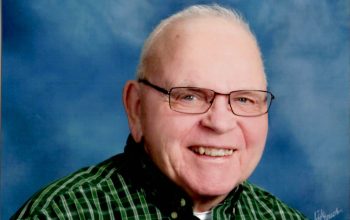
AREA- For Iowa Department of Education Director Dr. Ann Lebo, the Cedar Valley West partnership between Grundy Center, Gladbrook-Reinbeck, Dike-New Hartford and Aplington-Parkersburg isn’t just an example that can be used at other school districts across the state. It’s a personal point of pride, as she played a key role in getting it off the ground in the first place.
Lebo, a Grundy Center native, GCHS graduate and former teacher and principal in the district, still calls the community home, and she visited several area businesses during a tour on Monday, including Iowa State Bank in Parkersburg, Unverferth Manufacturing in rural Shell Rock and Napa/Farmer’s Feed and Supply in Reinbeck before wrapping up the day at the Natural Grind in Grundy Center.
“One of the things we want to be able to show is how schools can provide opportunity for students no matter what community they’re in. We just have to find out what it looks like,” she said. “What we’ve seen here is a great model for partnerships and different opportunities with everyone working together to really promote what’s best for kids… These opportunities in small towns and at these schools are just as valuable as opportunities anywhere else.”
The purpose of her trip, she added, was to examine what obstacles are in place and what barriers can be removed to allow more K-12 schools to create work-based learning opportunities. Cedar Valley West, for example, has worked in conjunction with Hawkeye Community College throughout its existence, and the Western Outreach Center, located, just south of the Highway 14-Highway 20 intersection, has served as a centrally located meeting point for the classes.
CVW Program Coordinator Stacy Ascher, who was originally hired by Lebo, sees her both as a mentor and a friend.
“She kind of pioneered a lot of the work that’s been happening with the Cedar Valley West, so I think (it’s been nice) having somebody start from the ground up but then has seen it evolve into what we are now,” Ascher said. “People, they see the importance of the community, the business and the schools all working together for the greater good.”
The goal is to encourage students who are preparing to graduate that they can return to these communities to live, work and raise families, and that there are a diverse range of businesses even in small town Iowa.
As part of an internship program, three Dike-New Hartford seniors have earned valuable experience working at Unverferth in Shell Rock. The students, Lincoln Cross, Gavin Lage and Jacob Klingenborg, have been interning as welders for the past two months. On average, they work around three hours per day, in addition to their high school schedules.
During her visit to Unverferth, Dr. Lebo highlighted this program and spoke with the students. The boys were also able to take college welding courses to further advance their skills. Unfortunately, due to COVID, they had to miss out on a large portion of the in-class instruction.
“We missed out a lot on the hands-on because of COVID, so having this internship was great in getting more experience,” Cross said.
Not only are all three of the seniors getting great experience, but they will soon be converting the internship into full-time positions, upon graduation. Director Lebo spent time speaking with them about their experiences while touring the Unverferth plant.
At the Natural Grind on Monday, Grundy Center Superintendent Robert Hughes said it was an honor to welcome Dr. Lebo back to her own community and show her the ways that the work-based learning initiatives continue to grow.
“It's just essential that you build partnerships and you develop it out of the community. If the community supports it, it will be successful,” Hughes said. “And if the community realizes how it brings new initiatives and new business because we’re helping sustain that and seeing our kids come back to be employed or to live here because they realize the value of that after graduation. That’s just really essential that we maintain the community support and partnership in establishing these programs.”
And for Lebo, who remembers asking students to go through phonebooks and develop databases of area businesses to help get the partnership off the ground, then teaching at the Western Outreach Center in its early days, watching the progress is almost like seeing one of her babies grow up.
“It is, and I brag about it everywhere I go. I tell people everywhere I go that this is kind of how it started, and there’s no reason you can’t do it,” she said. “There’s not a single school and a single community that can’t do this if they understand how, and my whole goal with this is to help people see how it can be done.”