By Casey Jarmes
John Vincent Armstrong considered himself to be one of the happiest sailors in the U.S. Navy. He’d grown up in What Cheer, never seeing the ocean until he’d enlisted. Vincent and his brother Terry had joined up in 1939, when much of the world was embroiled by war, but the U.S. was officially neutral. Before long, a third brother, Tommy, joined them. All three Armstrong brothers were assigned to the USS Oklahoma, a ship Vincent considered to be the grandest ship he’d ever imagined. “It was absolutely wonderful,” Vincent recounted to the What Cheer Patriot Chronicle in 2000. “I loved it.”
The Armstrong brothers were given jobs as storekeepers aboard the Oklahoma, with Vincent working in the paint store. In 1940, the Oklahoma docked at a sunny, beautiful naval base in Hawaii. That naval base, as you’ve no doubt guessed, was called Pearl Harbor, the location of the infamous Japanese surprise attack that drew the United States into World War II.
On Dec. 7, 1942, Vincent Armstrong woke up early to attend Mass, held by Chaplain Aloyisius Schmitt of Dubuque. After Mass he had breakfast, then stopped to “shoot the breeze” with his friend Bill Hellstern, a gunner’s mate from Peoria. Hellstern could feel that things were different. He told Vincent “War’s coming close. We’re so close to it, it’s not even funny.”
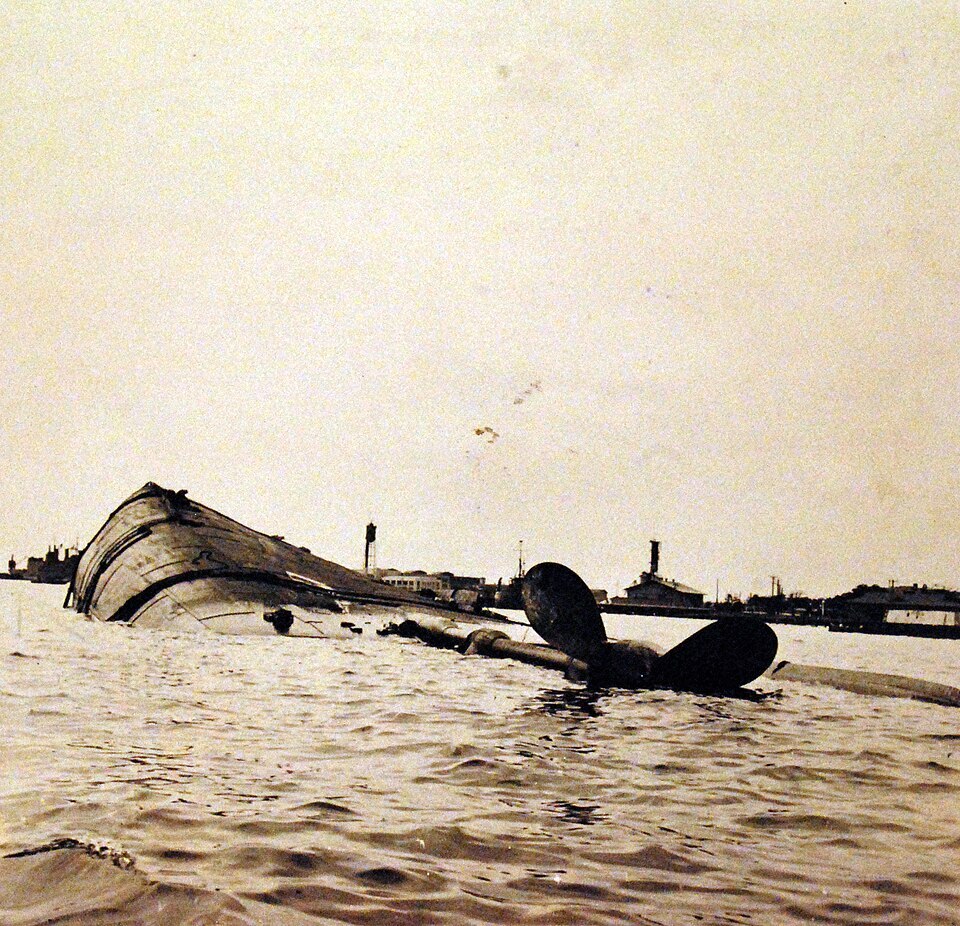
Then, another sailor yelled that the Japanese were attacking. The air alarm sounded, as five explosions shook the Oklahoma. Torpedoes, launched from Japanese planes. Vincent was tasked with running through the ship, sealing the hatches, water-tight compartments, and portholes. As he did, the ship began to list and water began rushing in through the portholes. Vincent scrambled through the flooded ship, climbing a ladder to reach a gun turret. By then, the ship had listed so hard the guns were almost pointed straight down into the water. Vincent climbed the wet, slippery gun turret. Another sailor stuck his leg down and Vincent grabbed it, allowing the sailor to pull him around the turret.
Then, Vincent realized there was nowhere else to climb to. The ship was sinking. He dove off, into the ocean, which was thick with oil. Behind him, the oil blazed. In front of him, half a mile away, was the port. Vincent Armstrong swam through the sea of oil, as Japanese planes flew above, firing into the water. Halfway to the shore, he was pulled out of the ocean by a rescue boat. Vincent got to work, helping pull other sailors out of the sea.
After returning to shore, Vincent Armstrong, having swallowed a lot of oil, went to the sick bay, where he reunited with his brother Terry. It took a week for the Armstrongs to find out Tommy was alright; he had survived the attack by leaping from the sinking Oklahoma onto the nearby USS Maryland.
The morning after the attack, Vincent climbed onto a rooftop and stared out at the harbor full sunken battleships. “I could see the mast of the Arizona, broken like a matchstick, leaning into the water,” he recounted in 2010. “That’s all you could see of the ship.”
Vincent’s friends Schmitt and Hellstern were among the thousands that perished in the attack. Schmitt died helping other men out of a hatch. Armstrong told the What Cheer Patriot Chronicle that Schmitt could have gotten out of the ship, but went back, to help others escape. Hellstern died at his battle station. After the war, Vincent visited Hellstern’s father, and had drinks with him, feeling it was something that he should do.
In 1942, after the infamous incident where the five Sullivan brothers from Waterloo died on the same ship at Guadalcanal, the Navy began a policy of assigning brothers to different ships. Vincent spent most of the war on shore duty in Australia. Terry remained at Pearl Harbor. Tommy was assigned to the USS Louisville, seeing five major and three minor battles during the war. All three Armstrongs survived the war.
The Armstrong brothers were not the only local men at Pearl Harbor on that fateful day; five other What Cheer men (Denny Dugger, Joe Karsten, Wesley Jordan, Chester Shacklett and Romeo Wilcox) were stationed at Pearl Harbor, as were Vernon and Raymond Hartgrave of Delta, George Sigafoose of South English, and potentially other local men who didn’t turn up in my research. Jordan and Shacklett were with the Armstrongs on the Oklahoma. Karsten was working guard duty on the shore. Dugger was working at a nearby airfield.
Irving “Bill” William Halleran of Long Island, whose family lives in Sigourney, was on the USS Phoenix during the attack; the Phoenix was unharmed, but Halleran was able to watch the sinking of the USS Arizona from the deck. “All I remember, when the Arizona took the big hit, was a lot of smoke and fire,” Halleran said in 2010, when he spoke to Amy Jones’s fifth-grade elementary class, which included his great-grandson Tanner, about Pearl Harbor. I am 90% sure I was in that class, but do not remember this event even slightly.
Lee Leyden of Montezuma, the son-in-law of Harriet Culp of What Cheer, had been stationed at Pearl Harbor until November of 1941; after his tour of duty ended, he remained on O’ahu, working as a taxi driver. Every morning, he was tasked with driver a general to Pearl Harbor. On December 7, Leyden, used to sound of practice bombings at the naval base, initially didn’t realize it was a real attack. Then, the radio announced the base had been attacked. Leyden’s boss ordered him to forget about fares and drive around, picking up anyone in a uniform he saw and taking them to the naval base. Leyden also took the general to the base. The general then opened a storage building and began handing guns and munition out to enlisted men and civilians alike. Later, Leyden helped haul wounded to the hospital. The hospital ran out of room, so he was forced to lay injured men on the grass outside.
After the attack, the government decided against releasing detailed information about the attack, including information on who was alright. Families of the men stationed at Pearl Harbor had to wait, with bated breath, for weeks, to find out if their sons had perished. The families of the Armstrong brothers, Sigafoose, and Karsten received letters from their sons before Christmas. Dugger, Shacklett and Wilcox’s families received letters at the start of January. It took until January 14 for the Jordans to find out that their son Wesley was missing, presumed dead. Wesley Jordan was 23, and had enlisted alongside his close friend Chester Schacklett in 1938. He married Leta Tish in 1940. And, on that day that lives in infamy, it’s likely Wesley Jordan perished, one of the 429 sailors aboard the Oklahoma who went down with the ship.