by Amanda Rink, Editor
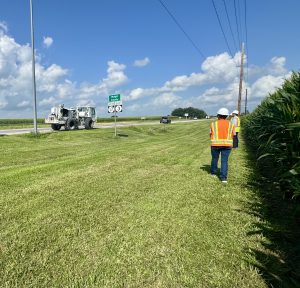
Under the hot Iowa sun and beside the sweating corn, I joined part of the Twin Rivers Exploration team just west of Goldfield, as they carried out seismic testing along Highway 3. Supervisor Betty Ellis was also present.
Leading the effort was Kyle Handy, a landman with Twin Rivers, alongside Robert Beal, project manager from Vantage Geophysical Corporation. When asked about the biggest hazard of their work, Beal didn’t mention the high-tech equipment or heavy trucks, instead, he pointed to the speeding traffic.
Wright County sits at the center of a growing effort to locate and extract natural hydrogen, a potentially game-changing clean energy source. Twin Rivers, one of several companies involved in this effort, is betting big on the area’s underground potential.
Beyond land value, or mineral right payouts, which Handy described as “highly material” in an earlier statement to The Wright County Monitor, a hydrogen operation could mean long-term job creation and infrastructure development.
The workday for the “shaker truck” began late, around 3:30 p.m., but the operation was already busy. Along the ditch of the highway, workers placed small, GPS-equipped nodes called geophones just inches into the soil. These geophones would soon record the vibrations produced by the seismic truck.
But the truck is only part of the operation.
A few yards ahead of it is Mike Kline, the technician responsible for monitoring PPV (peak particle velocity) the maximum level of ground movement allowed before testing must stop. If his meter hits 0.5 PPV, operations stop immediately until it’s safe to continue. Most things, footsteps, passing trucks, don’t register, but trains do.
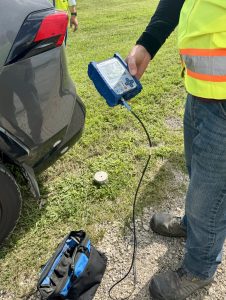
Mike isn’t employed by Twin Rivers or Vantage. He works for a third-party firm to ensure unbiased compliance with safety thresholds. All the data he collects is forwarded to Twin Rivers for interpretation.
This collaborative effort involves four entities: Koloma (the exploration rights holder), Twin Rivers (the local operator), Vantage Geophysical (handling field testing), and Integrated Geotechnical Solutions (compliance monitoring).
While I was on the jobsite, 65 nodes were shaken, with 638 nodes placed for the entire day.
So how does it work?
The seismic truck uses a heavy steel plate, sometimes rubber, but always covered with particle board, that drops to the ground and begins vibrating, sending waves through the subsurface. It’s brief, just a few seconds, and produces vibrations not unlike those from a passing semi.
I did not see the surface, like loose rock, moving while I was present.
As the waves travel underground, they bounce off different layers of rock and soil. These reflections are captured by the nodes, which convert the vibrations into electrical signals, data that will later be transformed into a 3D map of the underground structure.
Twin Rivers is specifically looking for formations shaped like inverted bowls, geological traps that may hold natural hydrogen.
Robert Beal explained that seismic testing isn’t limited to energy exploration. “We also help farmers locate field tile or assist engineers in understanding soil stability before construction,” he said. Vantage Geophysical has been operating for over a decade and, according to Beal, has never caused damage to drainage systems, though he shared that he has never worked in an area with tile as dense as Wright County.
That density has caused friction. Initially, Twin Rivers and Wright County agreed to a 250-foot buffer from county assets. Later, the company requested to reduce the distance to 50 feet, hoping to improve their scans. County officials did not reduce the setback.
For now, seismic testing is taking place along state highways unless private landowners agree to testing on their property. The operation is expected to continue for several more weeks.