By Casey Jarmes | The News-Review
Decades ago, during the summer, a common sight in Delta were the posters stapled to telephone poles. “THE NATIONALLY FAMOUS SCHAFFNER PLAYERS,” they said, “STARRING TOBY and SUSIE And Their Big Company of Comedians In America’s Most Beautiful TENT THEATRE.”
High schoolers would help the traveling performers set up their tent on the high school football field, in return for free tickets. Then, they would enter under a sign proclaiming that they were entering “America’s Only Folk Theater.” They would sit, in the crowded tent filled with hundreds of Deltans, and laugh as Toby and Susie performed their plays.
Our story begins in 1851. Yankee Robinson began “The Robinson Family,” the first American traveling tent theatre, visiting towns across the Midwest. Robinson sold it to Charles Emerson in the 1880s, who operated the theatre until 1910. Emerson sold the show to J.S. Angell, who renamed it “Angell’s Comedians.”
Neil Schaffner was born in Wapello, in 1892. When he was 14, and living in Fort Dodge, Schaffner and his friend Richard Colby began writing and producing their own plays in a small room above a blacksmith shop, quickly earning success locally. In 1922, Schaffner was hired to star in Angell’s show. In 1924 Schaffner saw a “tiny, red-haired ingenue” singing on a stage at Fort Dodge. Her name was Caroline Hannah. Neil Schaffner quickly hired Caroline for “Angell’s Comedians.” Not long after, the pair were wed.
Schaffner acquired a half partnership over the show shortly after being hired, acquiring full ownership from Angell in 1925. Renaming it “The Schaffner Players,” Neil, Caroline, and their troupe toured the Midwest, performing to massive crowds tents and opera houses. The Schaffner’s were a Repertoire Theatre, featuring a variety of different acts, including vaudeville, burlesque, musical comedy, and dramatic plays.
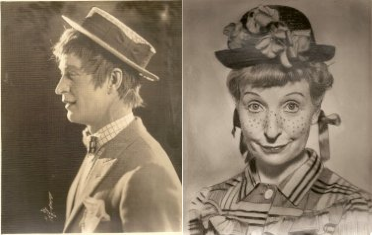
Neil Schaffner wrote, directed and starred in 175 plays over the years, most often as his beloved character, Tobias T. “Toby” Tolliver, a simple country bumpkin from the fictional town of Hosscratch Ark.
Schaffner performed wearing a scraggly red wig and freckles, often wearing a straw hat and bib overalls with one strap hanging down. Caroline joined him on stage as Susie B. Straight, a straight man with freckles and pigtails, typically dressed in Minnie Pearl hat and a calico dress. The typical play portrayed Toby as unsophisticated, awkward, and boisterous. Toby was gullible and naive, easily preyed on by conniving villains. At the same time, the character was cunning, with deep wit. The plays would generally feature Toby rising to heroism, blundering into victory in ways that look almost accidental.
Toby was inspired by other rube clowns of the era, like Tobe Haxton from the 1911 W. C. Herman play “Clouds and Sunshine.” However, Schaffner saw his starring role as being more than a slapstick stooge. To Schaffner, Toby was a symbol of honesty and good clean living, a boy next door with straitlaced morality and an instinctive desire to puncture pretense or expose greed and hypocrisy, who always managed to outwit the plays’ villains.
The Schaffners wowed audiences with their Toby and Susie plays. For decades, they travelled the gravel roads of rural America, performing around 20 locations a season, to 5-7,000 people a week. Each year, they acted in around seven different plays. They travelled with a cast and crew of around 18 people, spending each summer driving a 1,500 mile circuit across the Midwest. During winters, the Schaffners rested at their home in Cedar Rapids, where Neil wrote new plays.
The plays featured no programs, with Neil Schaffner, dressed as Toby Tolliver, coming out before each show to tell the audience what they were in store for. Very little changed about the Toby and Susie plays over the years, with an article I found from 1950 saying the only major change was the switch from candles to electric lighting. The plays found their success in their relatability; for example, in 1962, the people of Delta asked Neil Shaffner if his play “The Giggling Gossip” had been based on them, because they recognized the characters in it as being so similar to themselves.
To quote a 1962 article about the traveling tent show, “The plays have been called ‘corny’ or ‘small town,’ and Neil accepts the words as compliment – but they are misnomers. The plays amble along at a leisurely pace, but the humor and the wisecracks of the Schaffners are sharp as wire. They have an inborn sense of what is funny and what the audience hopes will happen and it does. And as it should, the ‘good guy or girl’ wins the struggle at the end of the play. Some of the plays are long and it takes quite a while for right to triumph over evil, but that is when the audience is watching closely and getting a lot of pleasure out of the turn of events.”
Tent shows like the Shaffners’ were incredibly popular, in the early 20th century. In 1927, the New York Times estimated that there were 400 tent theatre companies in the U.S., who had visited 18,000 communities and played to 76,800,000 people. In the 1920s, Iowa alone was estimated to have been visited by 110 different companies. But, by 1950, the Schaffner Players were one of only a dozen left. In 1957, they were one of only five theatre companies traveling Iowa.
Still, despite the growing popularity of radio and TV, the Schaffners were still packing shows across the Midwest. Some of their most adamant fans came in the small Keokuk County town of Delta. The Schaffners visited Delta again and again, with nearly the entire town coming to see their old friends Toby and Susie during each visit. When they visited in 1957, Mrs. Ernest Farmer of Delta came to the tent show with her grandsons, Dan and John Woods. She told a reporter that, in the 32 years the Schaffner Players has been touring, she hadn’t missed a single show in Delta. Generations of Delta residents watched the Schaffner’s shows.
Of course, all good things must come to an end. In 1962, Neil Schaffner, then 70-years-old, had a heart attack. On recommendation from his doctor, he decided to retire from his role as Toby Tolliver, after one final farewell tour. On June 9, 1962, Toby and Susie visited Delta for the final time, where they performed their hillbilly play “Feudin’ and Fightin’.” 1,000 people showed up for the show. The people of Delta gave Schaffner a framed certificate of appreciation, souvenir plate picture of the delta covered bridge, and a box of stationary. That night, Schaffner gave a farewell speech, saying that he and his cast were grateful for the many fine receptions they had been given in Delta, and the friendships they had acquired. Then, he abruptly stopped his speech, as his emotions got the best of him. The audience responded with thunderous applause.
The Schaffners sold their show to James Davis, a cast member who had first performed for them at a 1955 Delta show. Davis who continued performing as Tobias T. Tolliver II until his death in 1998. His wife Jaunita starred as Susie until 1979; Davis’s second wife, Grace, played the character from 1983 to 1998. After retiring, the Shaffners considered opening a Repertoire Theatre museum at the What Cheer Opera House. Caroline instead opened the museum in Mt. Pleasant in 1972. Neil Schaffner passed away in 1969. Caroline joined him 1998.
I’ll end this column with a quote, from a 1962 article about the Schaffners’ farewell tour.
“Of all the performers, Toby and Susie were two of the favorites. Their sassy plays opened a wider world to many unable to attend theaters. To the small towns, the Shaffners were big theater, city entertainment and pretty classy stuff. Whether the shows by the Shaffners have been good, bad, hokum or slapstick, they have widened the horizons of many in their early years. Anything that broadens the scope of the mind in comedy, pathos or any other area, is wonderful to that particular person, no matter how much they may learn later. The Schaffners gave a glimpse of human nature, of the rest of the world, peopled with familiar characters.”