By Casey Jarmes | The News-Review
“The heat of the night, added to the furious heat of the conflagration, was intense. The rush and hurry of the people was bewildering. Men and women felt themselves powerless as the results of their lives of labor were swept away. Many had no time to remove goods. Many others were away from home and their houses locked. Many of these were broken open and some of the goods hurried out into the disorder, other houses were left to burn without being touched.”
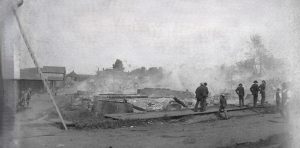
That’s what the What Cheer Patriot Chronicle wrote three days after the Great What Cheer Fire. On August 3, 1890, a horrible blaze tore through the small town with a population just over 3,000. It had been a hot day, and the small town hadn’t had rain in weeks. It was filled with wooden buildings that had dried out over the hot summer. The fire destroyed 48 homes or businesses, leaving thirty families homeless. More than $200,000 (that’s more than $7,000,000, with inflation) worth of property was consumed by the flames. The headline from local paper the What Cheer Reporter called it “Most Destructive Fire That Ever Occurred in Iowa,” although the actual article hedged its bets by saying it was only “probably” the most destructive Iowa fire. The Reporter wrote that “An area of more than three blocks converted into a mass of charred and blackened ruins.”
The fire began in a vacant building owned by the de Steiguer brothers, which had formerly been the location of the Famous Clothing Store and was located in the center of the city’s business district. Ten minutes after midnight, Merit Cochran and Harley Carl were heading home from their job at the electrical light plant, when they saw the glow of the flames. They ran over to investigate and discovered that the flames had spread to the meat market owned by Bud Armstrong. The pair screamed fire. The wife of J.H. Leathers heard their shouting and woke her husband, who rushed out with a bucket of water to try and quell the blaze. The screams were also heard by Roy Robison and Dr. Butler, who were sitting in front of the drug store. They ran down to city hall and rang the fire bell. The coal mine whistle screeched in emergency and hundreds of people rushed to the blaze.
The What Cheer Fire Department arrived, in their small steamer fire engine, and did what they could to stop the spread of the blaze. They managed to keep the fire from spreading south and consuming the railroad, but could not stop the fire from spreading north and west, devouring other buildings. The fire spread from Armstrong’s to Harlan & Parret’s general store and the Ashman Brothers Billiard Hall, then was carried across the street by the wind, burning down the Savings Bank, the K of P Hall, and J.H. Leathers’ Building. The fire cut the firefighters off from the northern cistern that they used to refill the engine, forcing them to contend with a limited water supply. The Reporter wrote that they “economized that every drop was made to count.”
Two of the firefighters, Roy Robison and Will Rosecrans, were overcome by the heat, but both returned to fighting the flames after recovering. Fred Schott’s foot was mashed, W.J. Ashley cut his hand while jamming a nozzle through window glass, and W.S. Yoder was badly burned, but none of the firefighters were seriously injured. Firefighter Bud Armstrong worked like a “Trojan,” according to the Reporter, and couldn’t talk for days after the fire. According to the Reporter, Armstrong asked some men watching the fire to help, and one man said “That the town might burn down for all he cared, and he wished it would all go.” Armstrong punched him, sending him flying fifteen feet; he rolled a further ten feet before coming to a stop, according to the newspaper.
Still, most of the town did what they could to fight the flames. To quote the Reporter, “If there were a few laggards among our people and some dogs who worked for plunder, the body of What Cheer citizens, men and women mingled in one heroic struggle to save the town.”
Neighbors carried buckets of water and beat flames with sticks to hold back the flames. Tom Burke and Al Geneva protected John Burke’s residence, having to hide their faces behind a chimney as they doused the flames to keep from being burned. The Reporter office caught fire, but Sam Gillroy and Cale Herendeen saved it using a wash-pan and a barrel of rainwater; the building ultimately only suffered cracked glass and blistered paint.
The firefighters and townsfolk worked until the blaze was finally extinguished at 1:55 a.m. The de Steiguer, where the fire had begun, was still standing when morning came. But, dozens of other buildings weren’t. “At last a great fire has come and the result of long years of honest toil have gone up in the heat and smoke of an hour,” wrote the Chronicle.
Several people took advantage of the chaos to pilfer from stores in town, stealing hundreds of dollars in goods. It’s kinda sinister, to steal, while all around you people are risking their lives to help other people. But, to quote the Reporter, “gratitude could not restrain the men on whom decency had no hold.” Two of thieves, Jim and Geo Lyle, were arrested day after fire for stealing from Lortscher Bros. store.
Ultimately, life went on in What Cheer. Most of the affected businesses found new locations by the end of the week, and reopened at their former residences after rebuilding.
That’s the story of the Great What Cheer Fire. Or, perhaps, more accurately, the story of the first Great What Cheer Fire. The town’s history of terrible fires didn’t end in 1890.