By Casey Jarmes | The News-Review
Last week, I covered German mechanic Bob Molkenthin’s experiences in the Western Front of WWI, ending with the German line being forced back and Molkenthin watching his best friend die to a British artillery shell. This week, I’m continuing to retell Molkenthin’s story, which he told to to the Keokuk County News in June, 1929.
In August, 1916, Molkenthin was sent to the Russian Front. While traveling there, he and his fellow soldiers were ordered to march through Berlin. Many of the men with him had families in Berlin. As they marched through the capital, they were followed by their heartbroken wives and children, who they had not seen since the beginning of the war. But, their officers forbade the soldiers from seeing their families, ordering them to keep marching in ordered lines. “It was a sad group of soldiers who boarded the train going north to the Russian line,” Molkenthin said.
Molkenthin’s company was sent to the Nareganwke River, 12 miles from the town of Rohatyn, then part of Austria-Hungary, now part of Ukraine. To get there, the company had to march 46 miles, carrying 86 pound packs, over a path fired on by Russian soldiers. Three of Molkenthin’s comrades were dead by the time they reached their post; Molkenthin blamed this on the men’s carelessness and ignorance of their surroundings.
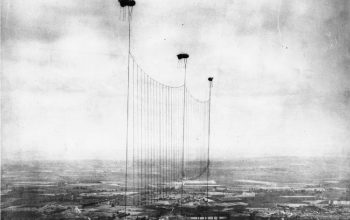
Late in the fall, two months after Molkenthin arrived, he encountered actual warfare for the first time. The Russians had set up base in a wide, U-shaped river bend encircling a mountain, with canons placed on the foot of the mountain. Molkenthin’s company spent two months hammering away at this stronghold, finally finding a weak spot on each side of the bend where the river started its swing around the base of the mountain. One afternoon, Molkenthin and another soldier were stationed in a balloon over the mountain, and spotted movement in the timber across the river. A squad of Russian soldiers were following the course of river, towards the German company. What’s more, the Russian canon on the mountain that jutted out the farthest had stopped firing.
They signaled for their balloon to be lowered and informed their commanding officer of what was happening, that the Russian force, which far out-numbered their company, was crossing the river via the weak spots to try and capture them. The officer repositioned their artillery, aiming at the weak spots. Molkenthin noted that, if there hadn’t been a swamp between the river and the mountain, that the they would have been cornered, leading the company to starve to death.
The Germans fled, running forty miles, the Russians at their heels. They started fleeing at two in the afternoon and continued running throughout the night and early morning, despite the soldiers and their horses being sore and weary. A heavy rain started, preventing either side from hauling their heavy cannons or packs. Then, the Russians, fearing German reinforcements, retreated, leaving their artillery behind.
Reinforcements arrived the next day. Molkenthin’s company caught up with the Russians before they could reach the river. After a short skirmish, the entire Russian company was captured. Molkenthin and his fellow soldiers were paid by the German government for the war material they captured; he stated that it was the “biggest pay day” he ever had.
Molkenthin was very critical of his commanding officers, writing that they were tyrannical and hated by the privates. During the battle by the river, after giving orders to their men, they ran away, taking the chuckwagon and the best horses with them. They did not stay to see what happened to the soldiers under their command. Molkenthin stated actions like this were unusual and that the officers, as a whole, didn’t have anything in common with their soldiers and either snubbed or ignored them.
“They idea that the German army was an army of inhuman beings is entirely wrong…the privates in the army were just like those in any allied army,” Molkenthin told the Keokuk County News. “They loved their homes, their families and their country. They did not want to follow out the orders of their superior officers except in isolated cases. Many of the officers told lies of the treatment the Germans received at the hands of the Allies and reports were sent out among the Germans of the inhuman treatment received from the Allies.”
Molkenthin stated that ambitiousness, even at the cost of the lives of those under them, was common among German officers. He attributed much of Germany’s defeat as being caused by the dissension between these officers and their privates. Molkenthin was also very critical of Kaiser Wilhelm, stating that he did not nor ever did have any admiration for the man and that Wilhelm’s only interest in the war was his own personal profit.
On the other hand, Molkenthin had nothing but praise for Germany’s generals, especially military leader Paul von Hindenburg, saying that “he was a soldier among soldiers, and a man loved by the entire army. He won the respect of all he came in contact.” This praise has aged very, very poorly. In the modern day, Hindenburg is mostly remembered for making Adolph Hitler Chancellor of Germany, signing the Reichstag Fire Decree and Enabling Act, and then dying, leaving Hitler with complete control over the country.
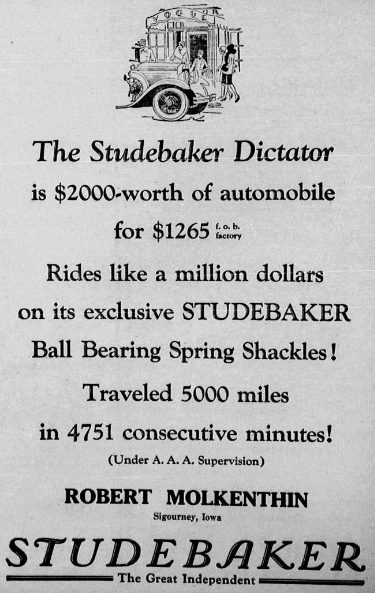
Molkenthin told the Keokuk County News that, during his time in France, Molkenthin began admiring the American soldiers, stationed in trenches less than a hundred yards away from him. After the war, he decided to come to America and get better acquainted with them. In 1926, he immigrated to the United States, opening a small automobile repair shop a block north of the Sigourney square. In 1933, he was naturalized as an American citizen. He passed away in 1956.