By Casey Jarmes | The News-Review
One Year: 1890
It was March 31, 1890. Henry Case was sitting at the North English restaurant owned by his close friend, John Stahl. The two of them began discussing the White-Caps, a KKK adjacent group that had been operating in the area. A few weeks earlier, the White-Caps had sent threatening letters to Keota man John Trensher, sealed with a skull and cross bones seal, leading Trensher and his family to flee town.
Case asked Stahl what he would do, if attacked by the White-Caps?. “This is what I would do!” replied Stahl, as he drew his revolver. He then shot Case in the head, killing him instantly. After the shooting, Stahl explained that he didn’t think the revolver had been loaded and that he had accidentally cocked it while drawing it.
This is the type of weird, forgotten bits of history I love to find, when doing my monthly dig through old newspaper archives. This week, I’m reading through the 1890 issues of the What Cheer Reporter. The reason I’ve chosen a What Cheer paper, rather than my typical Sigourney ones, is because, in 1890, with a population of 3,246, What Cheer was the largest town in the history of this county. This was the height of What Cheers mining boom. 1890 was the year What Cheer mines began using electric undercutting machines in the mines, as well as the year they began putting up electric streetlights in town.
On Jan. 5, Harper farmer John Smith and his brother, also named John Smith, bet Matt Bieven $10 they could out-pull a 1,400 pound mare owned by Bieven. A large crowd watched as John Smith and John Smith laid down on the ground, braced their feet against a stationary plank, and pulled against the mare at the end of a fifteen-foot rope. The John Smiths won.
On April 22, two tramps, William Evans and John McKinney got into an argument. Evans “applied a vulgar epithet to McKinney that cast serious reflections on the latter’s maternal ancestor.” McKinney responded by purchasing a .41 caliber revolver. Except, there were no .41 caliber rounds for sale in What Cheer. When Evans found out his rival had a gun, he purchased a .35 caliber revolver from the hardware, with the corresponding bullets. He fired at McKinney four times, missing each shot. Both men were arrested, with Evans claiming he had acted in self defense, something that failed to sway the grand jury.
On April 23, the Reporter ran an ad that said “THE NEW VIBRATOR. THE NEW VIBRATOR. THE NEW VIBRATOR.” These three words were repeated eight times. For context, the ad was selling a new threshing machine that separated seed via vibrations.
On May 7, a “smooth street faker” showed up outside the First National Bank in What Cheer, singing about bootleggers and Little Annie Rooney. Once a crowd had gathered, he began selling people dollars for only 50 cents and half dollars for only 25 cents. More than a hundred people clamored for his 50 cent dollars, which, I presume, were counterfeit. He also convinced the crowd to buy $5 writing pens (that’s about $182 with inflation) and pay to enter in a drawing for cash prizes ranging from $5 to $50. No one won the $50 prize. The faker walked away with $50, after assuring the townsfolk that he’d been to towns half as big with twice as many suckers.
Also in May, in Sigourney, Corporal Charles Lowe raced against a mule owned by a farmer north of town, which had been trained as a racer. The race was started by the dropping of a hat. Lowe won with ease; afterwards, Sheriff Johnson declared that the mule didn’t see the hat fall.
On Nov. 26, Dr. W. W. Eastburn of Webster led a town meeting to discuss the local hotel, which had five female employees, which was apparently more female help than was “consistent with propriety.” The day after the meeting, the hotel owner, Mrs. Anderson, showed up at Eastburn’s drug store to berate him. Eastburn was absent, but Anderson threatened violence. Two days after the meeting, Susan Misel and Jeannie Mesuard, two of the hotel workers, walked up to Eastburn, pulled out a billy club, riding whip and broomstick that were concealed in their dresses, and beat Dr. Eastburn. Both were arrested and Misel was let go for testifying against her other coworkers, who were then arrested.
The thing that I found interesting about the 1890 issues of the What Cheer Reporter was how little local news it featured. There were occasional local tidbits, but the bulk of the paper was dedicated to state, federal, and even international news, often taken from other newspapers. It even featured entire pages dedicated to excerpts from books, for example, running the 28-chapter historical fiction novel “Cleopatra” by H. Rider Haggard, a few chapters at a time, over the course of multiple months. This, I surmise, is because local newspapers served a different purpose back then. Radio was in its infancy, and the only source of any news was the local paper. If the people wanted to learn the important stories of 1890, like the opening of the Chicago World’s Fair, resignation of Otto von Bismarck, passing of the Sherman Anti-Trust Act, or Wounded Knee Massacre, they needed to go to a paper published in their hometown.
The What Cheer Reporter and its publisher, Richard Burke, were unabashedly loyal to the Democratic Party, calling the paper a “Weekly Democratic Paper” in its masthead. Although, given the fluidity of political parties, that doesn’t really mean the same thing it does today. Burke despised Republican President Benjamin Harrison and even more strongly despised Republican Congressman William McKinley, for McKinley’s staunch support of protectionist tariffs, which Burke called “The McKinley Monstrosity.” Burke even published a quite frankly bizarre fairy tale about the people of What Cheer being harassed by the worshipers of the evil deity Jee Oh Pea on Nov. 26.
Of course, there were parts of this 136-year-old newspaper that have aged, let’s say, poorly. In February, it ran a column by an Iowa man named E. S. Gibbs, opposing racist laws banning Chinese immigration…on the grounds that the Chinese were “as intelligent as the Negroes.” Gibbs wrote about how the U.S. had “civilized” the “worker race,” and advocated shipping Black Americans to Africa, so they could “enlighten the uncivilized.” He argued that the only reason this had not happened is because Republicans wanted Black people’s votes. Yikes.
The paper also frequently praised the the temperance movement as well as the labor movement, running frequent articles by British writer John W. Postgate about how American labor rights were 40 years behind those of England. The Reporter frequently praised newly elected Iowa Governor Horace Bois. Bois was an ardent advocate of the labor movement, establishing the eight-hour work day, creating laws to protect minors, and proclaiming Iowa’s first Labor Day. These politics were very popular in What Cheer. The city was a Democrat stronghold, with only one member of the city council being a Republican after the March 3rd election. And, this makes sense. What Cheer, at its peak, was a coal town, and coal miners traditionally were the most steadfast members of the labor movement, because of how dangerous and miserable their jobs were. The 1890 What Cheer Reporter issues were filled with stories of miners being injured, or even killed. That’s what we’ll discuss next week.
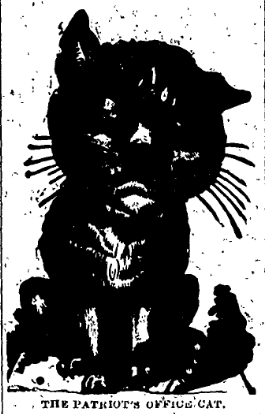
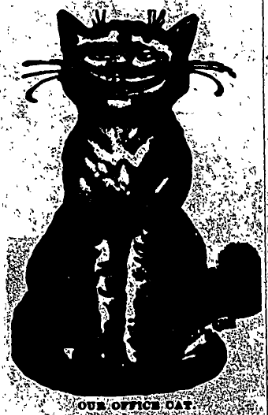
1890 is the oldest year I’ve touched, and it showed. Many of the old paper scans were either missing or too decayed to read. On Nov. 5, the Reporter ran a photo of their office cat, to prove it was cuter than the cat owned by their rival, the What Cheer Patriot. As you can see, it’s hard to tell, because these cats are not recognizable as cats.