By Casey Jarmes
The year was 1873. Crawford Walker, a man from the Liberty Township with a bad reputation, robbed the Lee & Johnson store in Talleyrand, stealing $800 worth of goods ($21,319.93 with inflation). To catch Walker, Keokuk County Sheriff Andrew Stranahan decided to go undercover. He walked on foot to the Liberty Township, pretending to be a day-laborer, and spent several weeks working for Walker’s neighbor, slowly ingratiating himself with Walker and his friends. After being let into Walker’s home and seeing the stolen goods, Stranahan gathered a posse and surrounded the house. Some of the stolen goods were recovered, but Walker managed to escape through a window.
Walker was arrested in Washington County the following year and sentenced to three years for burglary. In 1875, he also managed to escape from a jail in Fairfield. He was arrested in Marion County for highway robbery in 1876 and sent to a jail in Oskaloosa, which he managed to escape from. Walker was arrested in Missouri in 1877 and taken back to the jailhouse in Sigourney, where he, and this may come as a shock, once again attempted to break out of jail. Walker sawed through the bar holding the cell shut using a pocketknife and ambushed the jailer, Mr. Haudek (no first name listed in the history book). Walker and the other prisoners ganged up on Haudek, but Haudek grabbed onto the thief and refused to let him go. When help arrived, the other prisoners were gone, but Walker was still there, kept in place by Haudek. Walker remained imprisoned for the rest of his sentence at a penitentiary in Fort Madison.
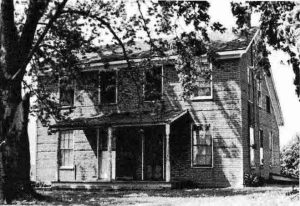
Now that our true crime appetizer has been completed, let us move onto our main course, the murder. The most infamous story from Talleyrand came on the twelfth of August, 1898, in the home of Jacob Geier, a local well digger and handyman. Geier was born in Beirschgorf, Germany, in 1853, and immigrated to the United States in 1881. A newspaper article written after the shooting stated that Geier had “Always drank more or less. Less when money was scarce. More since he received the money from the estate in Germany.”
The infamous shooting began, like many unfortunate incidents, with a keg of beer. William “Dutch Bill” Berend paid an acquaintance of his, teamster Frank Hilliard, to purchase a keg of beer in Harper and bring it back to the cellar of his friend Jacob Geier. Hilliard delivered the keg and the trio began drinking. An argument broke out between Hilliard and Berend about the cost of the keg, leading Geier to kick Hillard out. Hilliard returned that evening, asking for more beer. Geier again told him to get lost.
Hilliard returned, again, accompanied by Mathias “Matts” Mohrain, a 47-year-old farmer who had served alongside Geier in the German army. Hilliard and Mohrain went down into the cellar, grabbed a pitcher of beer, and began drinking in Geier’s home. Geier ordered his children to lock the cellar door. When Mohrain and Hillard asked for another pitcher, Geier told them no, but Berend unlocked the cellar and returned with another pitcher. After drinking the second pitcher, Mohrain went down and filled up the pitcher and a half gallon jar. He told Morhain he was going to take it to his sick wife. Geier, annoyed at the lie, told Mohrain to leave. Mohrain offered to pay for the beer, but Geier led him to his gate and kicked him out. Matts Mohrain attempted to come back into the house and was kicked out three more times, the last of which via a vigorous shove from Geier. After ridding himself of Mohrain, Geier went into the house and grabbed his revolver.
Then came the return of a man who was completely incapable of getting the hint: Matts Mohrain. Mohrain said he’d come back to get his hat and Geier cursed at him. The two argued and Morhain struck Geier in the head with a lantern, splitting his forehead open. Geier responded by shooting Mohrain in the head. The sheriff arrived and Geier gave himself over without resistance, saying “I am guilty. But I want justice.” He requested to spend the night with his family, but this request was refused. After the shooting, Geier vowed to never drink again. After 15 hours of deliberation, he was found guilty of murder and sentenced to fifteen years. He was paroled after six. He died in 1919.
As for Talleyrand, the small village died a slow death in the early 20th century. An 1880 Keota Eagle article about Talleyrand wrote the following: “This is one of the very few towns that holds its own and keeps up a good trade with a railroad passing nearby. Most of the towns dwindle and die when they are left by a railroad as Talleyrand has been. When the road was built through here, everybody said Talleyrand was dead but that prediction has proved to be untrue.” This article was a bit too optimistic.
It was a town built around being a stage-coach stop between Sigourney and Washington, something that became far less important when trains and later automobiles came to this county. In 1909, the town stopped appearing on maps. In 1928, the post office closed. In 1950, only 21 people still lived in Talleyrand. Now, all that remains is a cemetery, where the body of Matts Mohrain rests.